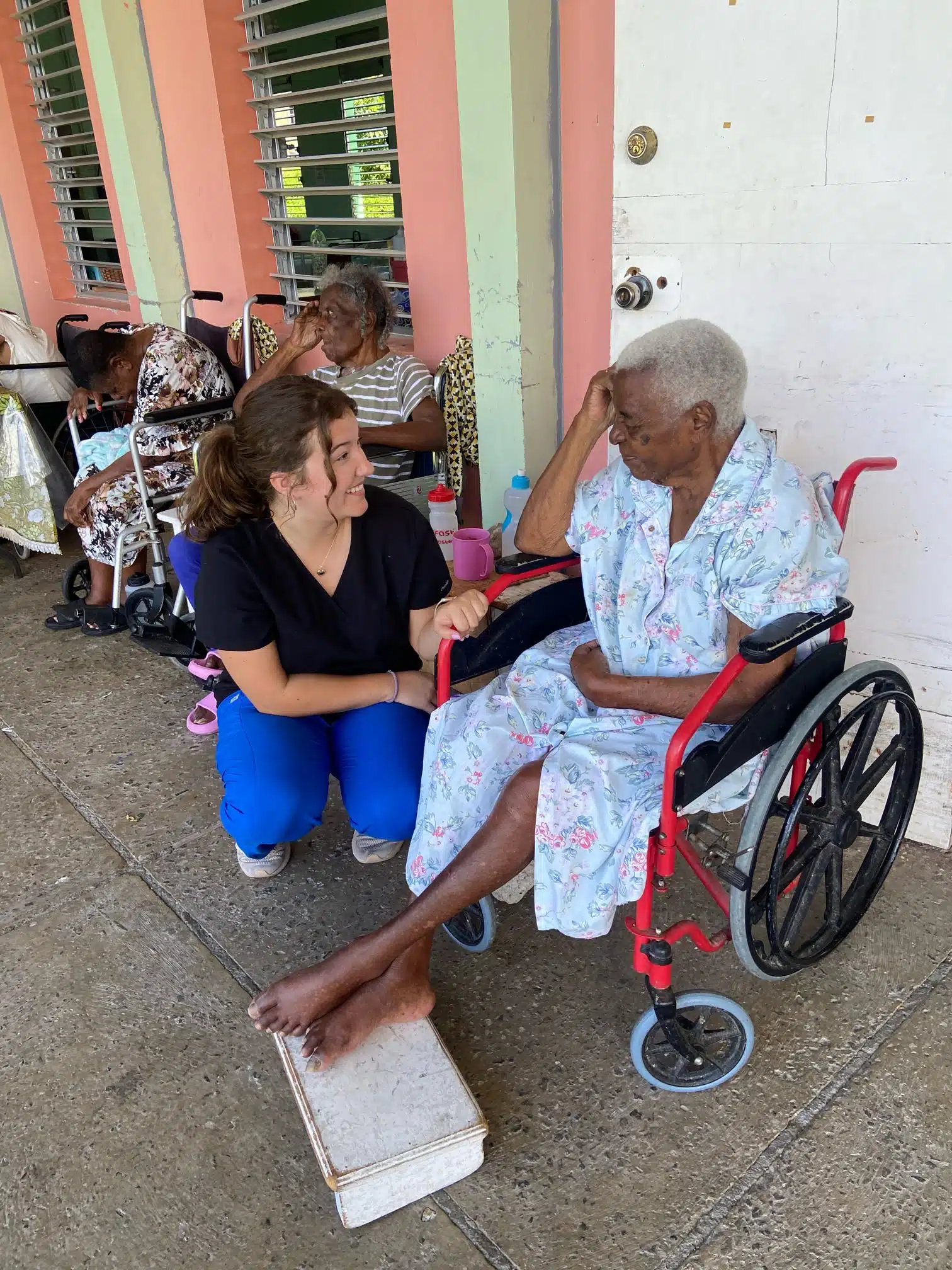
Physical therapy in Belize offers a unique opportunity to combine clinical education, cultural humility, and meaningful community engagement. In many parts of Belize, individuals recovering from stroke, injury, or chronic illness face limited access to rehabilitation services. Through partnerships with local providers and community organizations, Therapy Abroad supports sustainable models of care while offering immersive learning experiences for physical therapy students and faculty.
Physical therapy in Belize challenges students to think creatively, adapt evidence-based practice in low-resource environments, and engage directly with patients and families in ways that extend far beyond traditional classroom learning. To better understand the value of this experience, I spoke with Rebecca Medendorp, a professor in the Doctor of Physical Therapy program at High Point University, who has been traveling to Belize with Therapy Abroad for the past three years.
Kris: You have been bringing physical therapy students to Belize for several years now. What makes traveling with Therapy Abroad unique for you and your students?
Rebecca: What makes Therapy Abroad different and special is the amazing amount of support. That support starts long before the trip and continues once we are on the ground. There are local experts who know the area, know the patients, and know the community. They help connect us with appropriate patients and guide us through where we are staying and working. Therapy Abroad supports us on multiple levels and makes it really easy to prepare for these trips and focus on student learning.
Kris: You mentioned that there are many moments that stay with you. Is there one story from Belize that you will always take home with you?
Rebecca: There are honestly hundreds of stories, but one that really stands out is a man who had suffered a stroke. He had been sent home from the hospital and had been using a wheelchair for over a month. We were the first people to get him back up on his feet and show his family that he could potentially regain the ability to walk. His family was crying, we were crying. It was incredibly powerful to see that hope and to watch the patient realize that there was a future where he could walk again. It was also special to see the students be the ones to help provide that hope.
Kris: What has been your proudest moment watching students during these trips?
Rebecca: I love seeing the light bulbs go off for students. They usually have some clinical experience before coming, but this environment is very different. We have limited equipment and limited resources, so students have to rely on their hands and their creativity. Watching them realize that they can still make a real impact, even as students, is incredibly rewarding to be a part of.
Kris: Not every moment is serious. What made you laugh the hardest on this trip?
Rebecca: A lot of our funniest moments have involved tarantulas. It usually means turning over a trash can and escorting a fuzzy critter out of the room. Most of my tear-laughing, belly-laughing moments in Belize have involved tarantulas. I will say, though, I have only seen two in three years, so you might not even see one at all.
Kris: After returning multiple years, what do you feel most proud of when you are in Belize?
Rebecca: I feel most proud of the connections we make. We build relationships with patients and get to see them again in future years. They give us updates on their families and their lives, and we see how we have impacted them. The connections with the local staff and skilled nursing facilities are also very real. I still reach out to many of those people to this day. There are lots of hugs, lots of tears, and a lot of genuine appreciation.
Kris: If you had to describe this experience in one word, what would it be?
Rebecca: Impact. We are there for about a week, but the impact on student learning, on patients, and on the community is life-changing.
Physical therapy in Belize illustrates how short-term global programs can produce long-term outcomes when they are grounded in partnership, reflection, and community trust. For students, these experiences foster clinical confidence, adaptability, and professional identity. For communities, they expand access to care and reinforce collaborative relationships that continue year after year.
Programs like physical therapy in Belize through Therapy Abroad demonstrate that global clinical education is not about observation alone. It is about contribution, connection, and impact that extends well beyond the duration of the trip.
If you are a student, educator, or clinician seeking a global experience rooted in ethical engagement and meaningful learning, physical therapy in Belize offers a powerful model for what international education can be.
Global Health. Local Impact.
 Share
Share
 Tweet
Tweet
 LinkedIn
 Pin
Pin
 Email
Email